

Keywords
commemorations
antagonism
deliberative quality
DQI
Twitter/X
large language models (LLMs)
cross-country analysis
How to Cite
Abstract
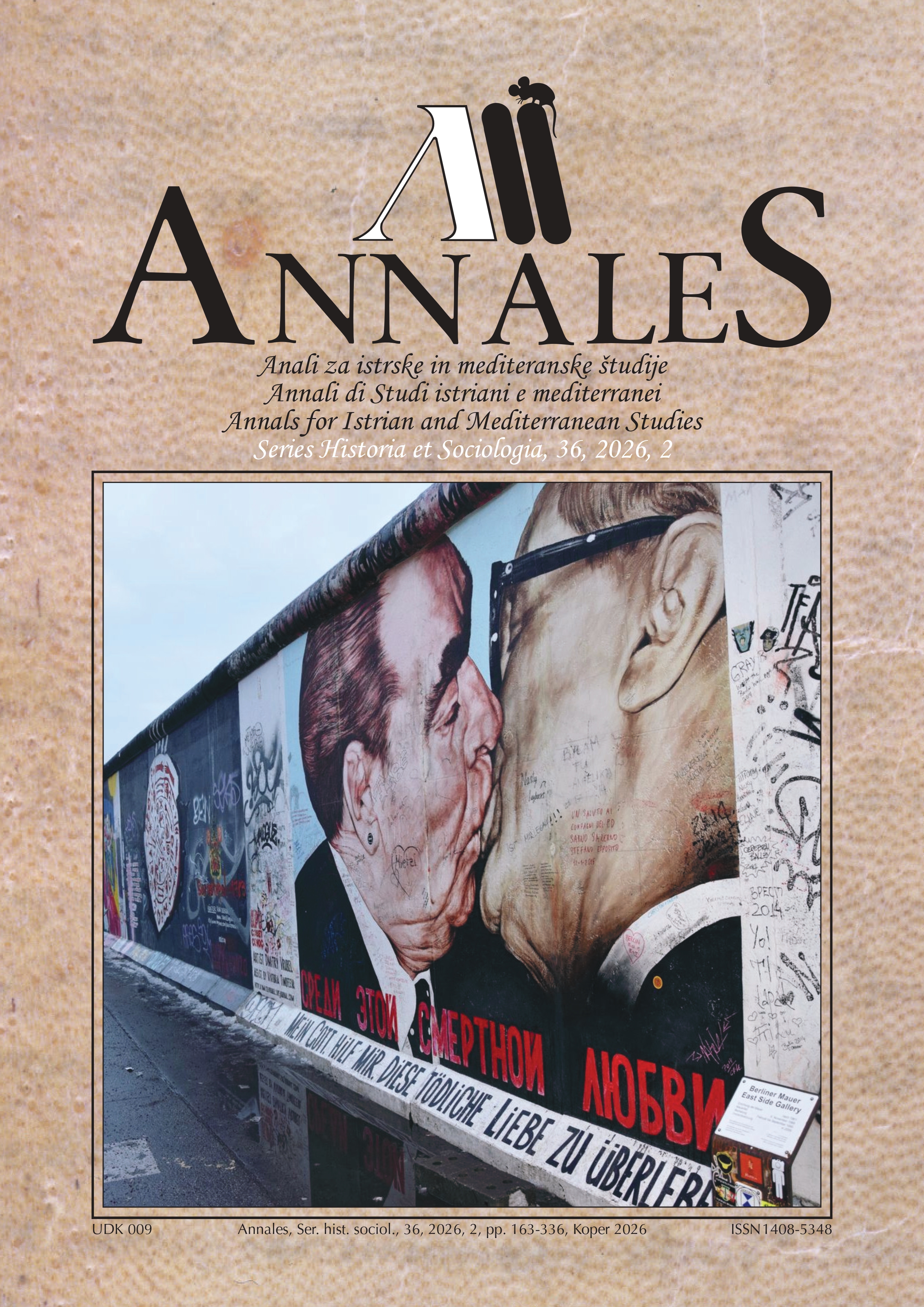
This article compares how Europe Day and the fall of the Berlin Wall are discussed on Twitter/X in Slovenia, Italy, Germany, and France. We treat these public events as commemorative cues that prompt users to interpret contemporary political conflicts through salient European historical references. Using an LLMassisted three-step design, we identify whether posts are conflictual, whether conflict takes an antagonistic or non-antagonistic tone, and whether it contains DQI-style deliberative signals such as justification, reciprocity, constructiveness, and respect. Topic modelling identifies thematic hotspots where conflict, antagonistic tone, and lower deliberative quality concentrate. The findings show that antagonistic tone generally lowers deliberative quality, but does not automatically eliminate reason-giving or constructiveness.
References
Assmann, Aleida (2014): Transnational Memories. European Review, 22, 4, 546–556.
Assmann, Jan & John Czaplicka (1995): Collective Memory and Cultural Identity. New German Critique, 65, 125–133.
Bachtiger, Andre, Shikano, Susumu, Pedrini, Seraina & Mirjam Ryser (2009): Measuring Deliberation 2.0: Standards, Discourse Types, and Sequenzialization. Proceedings of the ECPR General Conference. Potsdam, September 2009.
Behrendt, Maike, Wagner, Stefan Sylvius, Ziegele, Marc, Wilms, Lena, Stoll, Anke, Heinbach, Dominique & Stefan Harmeling (2024): AQuA – Combining Experts’ and Non-Experts’ Views to Assess Deliberation Quality in Online Discussions Using LLMs. In: Proceedings of the First Workshop on Language-driven Deliberation Technology (DELITE) @ LREC-COLING 2024, 1–12. Torino, ELRA and ICCL.
Bernhard, Michael & Jan Kubik (eds.) (2014): Twenty Years After Communism: The Politics of Memory and Commemoration. New York, Oxford University Press.
Blokker, Paul (2021): Narratives of Integration: A Holistic Approach to European Legitimacy. SSRN, 29 October.
Boukes, Mark (2025): Deliberation in Online Political Talk: Exploring Interactivity, Diversity, Rationality, and Incivility in the Public Spheres Surrounding News vs. Satire. Journal of Communication, 75, 2, 125–136.
Boursier, Axel, Radut-Gaghi, Luciana & Isabelle Boyer (2021): Le discours mediatique de commemoration. Quand le present est tenu par le discours. Communication, 38, 1.
Bresciani, Marco (2021): Fascism, Anti-Fascism and the Idea of Nation: Italian Historiography and Public Debate since the 1980s. Contemporary European History, 30, 1, 111–123.
Bull, Anna C. & Hans Lauge Hansen (2016): On Agonistic Memory. Memory Studies, 9, 4, 390–404.
Cabrero, Lorena Ortiz & Aline Sierp (2025): Memory, Post-Fascism and the Far-Right. Italian Political Science Review / Rivista Italiana di Scienza Politica, 55, 2, 186–199.
Canute, Matt, Jin, Mali, Holtzclaw, Hannah, Lusoli, Alberto, Adams, Philippa, Pandya, Mugdha, Taboada, Maite, Maynard, Diana & Wendy Hui Kyong Chun (2023): Dimensions of Online Conflict: Towards Modeling Agonism. In: Bouamor, Houda, Pino, Juan & Kalika Bali (eds.): Findings of the Association for Computational Linguistics: EMNLP 2023. Singapore, Association for Computational Linguistics, 12194–12209.
Chopin, Thierry & Christian Lequesne (2010): 20 Years after the Fall of the Berlin Wall: Freedom is the New Common Narrative of Europe. In: State of the Union 2010: Schuman Report on Europe. Paris, Springer, 43–49.
Damčević, Katarina (2025): “Ready for the Homeland”: The Semiotics of Hate Speech and Memory in Post-Conflict Croatia. Annales, Series Historia et Sociologia, 35, 4, 443–458.
Deodhar, Bhakti (2021): Inside Contested Cultural Memory: The Alternative fur Deutschland and the Struggle over German History. German Politics and Society, 39, 4, 1–26.
Detiček, Nuša & Maruša Pušnik (2025): Memory and Gender: Women in Museum and Textbook Representations of the Second World War in Slovenia. Annales, Series Historia et Sociologia, 35, 1, 109–122.
de Vries, Catherine E. (2022): How Foundational Narratives Shape European Union Politics. Journal of Common Market Studies, 61, 4, 867–881.
Focardi, Filippo (2016): Antifascism and the Resistance: Public Debate and Politics of Memory in Italy from the 1990s to the Present. In: Garcia, Hugo, Yusta, Mercedes, Tabet, Xavier & Cristina Climaco (eds.): Rethinking Antifascism: History, Memory and Politics, 1922 to the Present. New York – Oxford, Berghahn Books, 258–275.
Forrester, Sibelan, Zaborowska, Magdalena J. & Elena Gapova (eds.) (2004): Over the Wall/After the Fall: Post-Communist Cultures through an East-West Gaze. Bloomington, Indiana University Press.
Fournier-Tombs, Elisabeth & Michael K. MacKenzie (2021): Big Data and Democratic Speech: Predicting Deliberative Quality Using Machine Learning Techniques. Methodological Innovations, 14, 2.
Gutman, Yifat & Jenny Wustenberg (eds.) (2023): The Routledge Handbook of Memory Activism. London, Routledge.
Gwet, Kilem Li (2014): Handbook of Inter-Rater Reliability: The Definitive Guide to Measuring the Extent of Agreement Among Raters. 4th ed. Gaithersburg, MD, Advanced Analytics, LLC.
Heller, Ayline & Peter Schmidt (eds.) (2024): Thirty Years After the Berlin Wall: German Unification and Transformation Research. London – New York, Routledge.
Horvat, Marjan (2026): From Memory Regimes to Discursive Modes: A Theory-driven Framework for Analysing Cultural Memory in Hybrid Public Spheres. Zenodo.
Horvat, Marjan, Koražija, Jure, Babnik, Jan, Tratnik, Polona, Škvorc, Tadej, Lampe, Urška, Ergaver, Angelika, Oman, Žiga, Darovec, Darko & Marko Robnik Šikonja (2025): Communicative Memory. Deliverable D1.4 (Report), SoMe4Dem – Social Media for Democracy (Horizon Europe, Grant Agreement No. 101094752). Institute IRRIS for Research, Development and Strategies of Society, Culture and Environment, 6 September 2025. https://files-www.mis.mpg.de/mpi-typo3/SoMe4Dem/Deliverables/D1.4__Communicative_Memory_-_FINAL.pdf (last access: 2026-06-17).
Jaidka, Kokil (2022a): Talking Politics: Building and Validating Data-driven Lexica to Measure Political Discussion Quality. Computational Communication Research, 4, 2, 486–527.
Jaidka, Kokil (2022b): Developing a Multilabel Corpus for the Quality Assessment of Online Political Talk. In: Proceedings of the Thirteenth Language Resources and Evaluation Conference (LREC 2022). Marseille, ELRA, 5503–5510. https://aclanthology.org/2022.lrec-1.589/ (last access: 2026-06-17).
Klein, Mark & Nouhayla Majdoubi (2024): The Medium Is the Message: Toxicity Declines in Structured vs Unstructured Online Deliberations. World Wide Web, 27, 31.
Krastev, Ivan & Stephen Holmes (2019): The Light that Failed: A Reckoning. London, Allen Lane.
Kuljić, Todor (2012): Kultura spominjanja: teoretske razlage uporabe preteklosti. Ljubljana, Znanstvena založba Filozofske fakultete.
Larat, Francois (2005): Present-ing the Past: Political Narratives on European History and the Justification of EU Integration. German Law Journal, 6, 2, 273–290.
Levy, Daniel & Natan Sznaider (2002): Memory Unbound: The Holocaust and the Formation of Cosmopolitan Memory. European Journal of Social Theory, 5, 1, 87–106.
Luthar, Oto & Heidemarie Uhl (eds.) (2019): The Memory of Guilt Revisited: The Slovenian Post-Socialist Remembrance Landscape in Transition. Gottingen, V&R unipress / Vienna University Press.
Maddison, Sarah (2016): Conflict Transformation and Reconciliation: Multi-level Challenges in Deeply Divided Societies. London, Routledge.
Meyer, Erik (2008): Memory and Politics. In: Erll, Astrid & Ansgar Nunning (eds.): Cultural Memory Studies: An International and Interdisciplinary Handbook. Berlin, Walter de Gruyter, 173–180.
Mouffe, Chantal (1999): Deliberative Democracy or Agonistic Pluralism. Social Research, 66, 3, 745–758.
Mouffe, Chantal (2013): Agonistics: Thinking the World Politically. London – New York, Verso.
Mussou, Claude (2022): La chute du mur de Berlin: evolutions des representations. INAtheque. https://inatheque.hypotheses.org/31018 (last access: 2026-06-17).
Naab, Teresa K., Ruess, Hanna-Sophie & Constanze Kuchler (2025): The Influence of the Deliberative Quality of User Comments on the Number and Quality of Their Reply Comments. New Media & Society, 27, 1, 62–83.
Nienass, Benjamin (2023): Between Conflict and Consensus. In: Gutman, Yifat & Jenny Wustenberg (eds.): The Routledge Handbook of Memory Activism. London – New York, Routledge, 454–458.
Olick, Jeffrey K. (2007): The Politics of Regret: On Collective Memory and Historical Responsibility. New York, Routledge.
Olick, Jeffrey K., Sierp, Anna & Jenny Wustenberg (2023): Introduction: Taking Stock of Memory Studies. Memory Studies, 16, 6, 1399–1406.
Pariser, Eli (2011): The Filter Bubble: What the Internet Is Hiding from You. New York, Penguin Press.
Pistan, Carna (2020): Collective Memory in the Context of European Integration Processes: Some Critical Reflections on the EU Politics of Remembrance. De Europa, 3, 2, 21–38.
Pušnik, Maruša (2019): Media Memorial Discourses and Memory Struggles in Slovenia: Transforming Memories of the Second World War and Yugoslavia. Memory Studies, 12, 4, 433-450.
Richardson-Little, Ned, Merrill, Samuel & Leah Arlaud (2022): Far-Right Anniversary Politics and Social Media: The Alternative for Germany’s Contestation of the East German Past on Twitter. Memory Studies 15, 6, 1360–1377.
Rutten, Ellen, Fedor, Julie & Vera Zvereva (eds.) (2013): Memory, Conflict and New Media: Web Wars in Post-Socialist States. London, Routledge.
Schmidtke, Oliver (2023): Competing Historical Narratives: Memory Politics, Identity, and Democracy in Germany and Poland. Social Sciences, 12, 7, 391.
Steenbergen, Marco R., Bachtiger, Andre, Sporndli, Markus & Jurg Steiner (2003): Measuring Political Deliberation: A Discourse Quality Index. Comparative European Politics, 1, 1, 21–48.
Tornberg, Petter (2018): Echo Chambers and Viral Misinformation: Modeling Fake News as Complex Contagion. PLOS ONE, 13, 9, e0203958.
van Dijck, Jose (2007): Mediated Memories in the Digital Age. Stanford, CA, Stanford University Press.
Verovšek, Peter J. (2021): Memory and the Future of Europe: Rupture and Integration in the Wake of Total War. Manchester, Manchester University Press.
Viol, Maren, Anastasiadou, Constantia, Todd, Louise & Eleni Theodoraki (2024): Deconstructing Commemorative Narratives: The Anniversaries of the Fall of the Berlin Wall. Leisure Studies, 43, 1, 153–170.
Winter, Jay (2008): Sites of Memory and the Shadow of War. In: Erll, Astrid & Ansgar Nunning (eds.): Cultural Memory Studies: An International and Interdisciplinary Handbook. Berlin, Walter de Gruyter, 61–76.
Zec, Slavica, Soriani, Nicola, Comoretto, Rosanna & Ileana Baldi (2017): High Agreement and High Prevalence: The Paradox of Cohen’s Kappa. The Open Nursing Journal, 11, 211–218.
Zehring, Maximilian & Emese Domahidi (2022): Thirty Years After the German Reunification — Exploring Stereotypes About East Germans on Twitter. International Journal of Communication, 16, 4028–4051.
Zupančič, Rok, Ioannidis, Nikandros & Faris Kočan (2021): The European Union’s (In)Ability to Address Troubled Past(s): Voices from Eight European Countries. Annales, Series Historia et Sociologia, 31, 4, 547–560.

This work is licensed under a Creative Commons Attribution 4.0 International License.
Copyright (c) 2026 Marjan Horvat, Jure Koražija